The Operational Problem
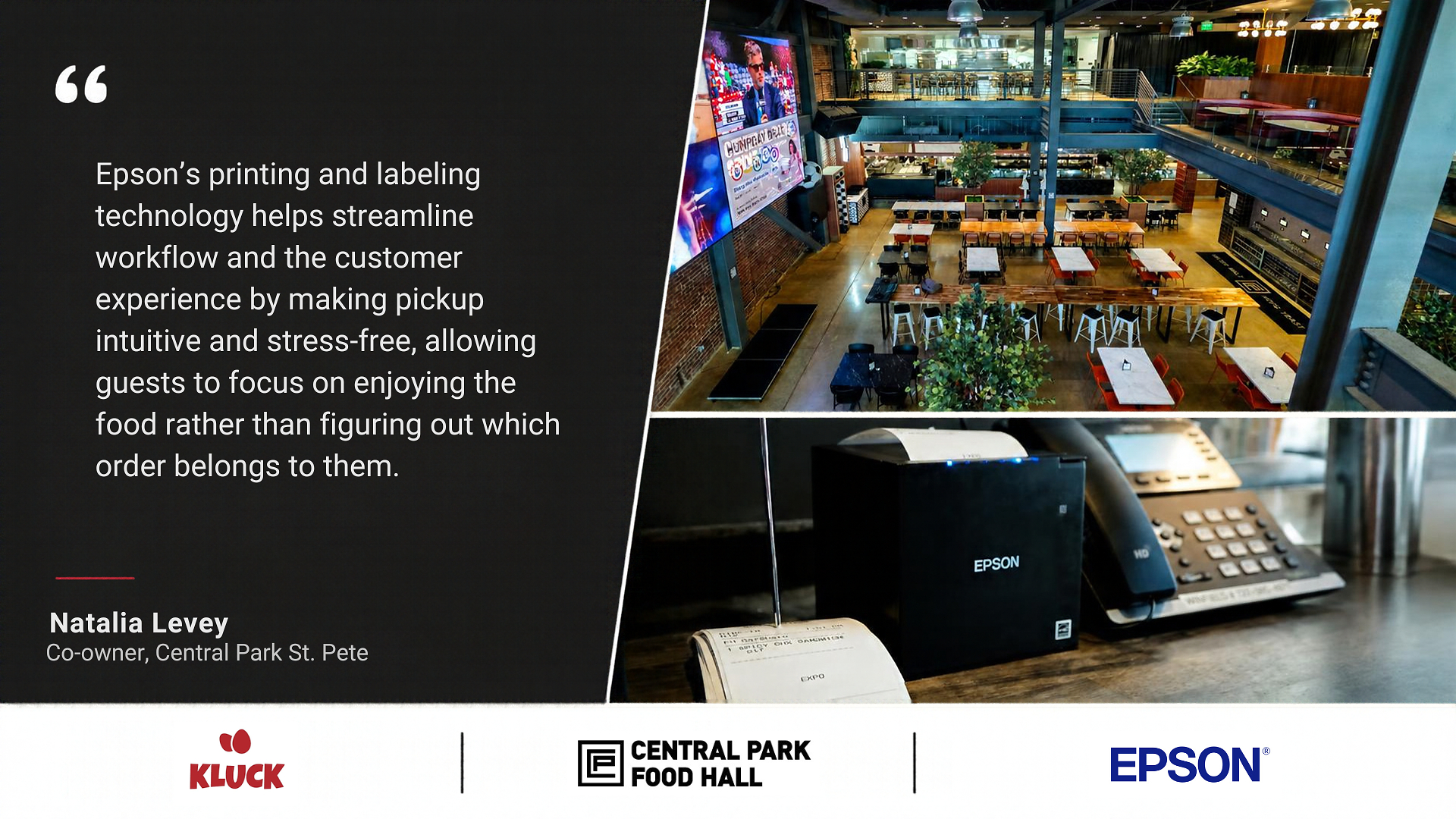
Central Park St. Pete Food Hall, a multi-concept dining destination in St. Petersburg, Florida, has standardized on Epson OmniLink TM-L100 liner-free thermal label printers at every vendor stall and OmniLink mSeries receipt printers at bars and expo stations — a full-facility commitment designed to solve the order-pickup confusion that plagues multi-vendor food halls.
The core challenge: guests at food halls often order from several concepts in one transaction, but individual kitchens prepare items independently and on different timelines. Without a coordinated labeling system, staff and guests alike struggle to match finished items to the right ticket. At Central Park St. Pete, each order label prints the guest's name directly, so pickup across multiple stalls requires no guesswork.
How the Platform Works
The technology stack runs on Kluck, a cloud-native restaurant technology platform that routes a single guest transaction to multiple kitchens simultaneously. Epson's ePOS technology ties into Kluck's platform, triggering label generation at the correct vendor location in real time — no manual intervention required from floor staff.
"Getting orders to the kitchen isn't the challenge — it's everything that happens afterward," said Cary Hicks, co-founder of Kluck. "Food halls create a unique operational challenge because a single transaction needs to be routed to multiple kitchens simultaneously. Epson's solutions allow us to automatically generate labels at the correct vendor location in real time, ensuring every item is clearly identified and ready for pickup without adding extra steps for staff."
Guests order via kiosks or QR codes, pay once, and collect food from individual stalls throughout the venue. Natalia Levey, co-owner of Central Park St. Pete, said the setup makes a multi-vendor visit feel like a single-restaurant experience: "Whether guests order at a kiosk or online for takeout, it feels like one cohesive experience. Epson's printing and labeling technology helps streamline workflow and the customer experience by making pickup intuitive and stress-free."
Why It Matters for Foodservice Operators
The food hall format has grown steadily as a foodservice channel, giving independent operators shared infrastructure and foot traffic while maintaining distinct menus and branding. The operational friction — particularly around order routing and fulfillment accuracy — has historically been a barrier to scaling the model cleanly. Standardizing print hardware across a facility, rather than letting individual vendors run mismatched systems, is an increasingly common fix that larger multi-unit restaurant technology deployments have adopted.
Hicks said the St. Pete installation is now a proof-of-concept for a broader rollout: "Central Park St. Pete proved the model, and we're now bringing the same Kluck and Epson solution to food halls and multi-vendor operators across the country."
For operators evaluating similar builds, liner-free thermal label media eliminates the backing paper waste and jam risk associated with traditional label stock — a back-of-house maintenance reduction that adds up across high-volume stalls. Ian Livesay, product manager at Epson America, Inc., framed the broader application: "Whether it's a traditional restaurant or a multi-vendor venue, accurate labeling and reliable networked printing play an important role in creating efficient workflows and positive guest experiences."
Written by Michael Politz, Author of Guide to Restaurant Success: The Proven Process for Starting Any Restaurant Business From Scratch to Success (ISBN: 978-1-119-66896-1), Founder of Food & Beverage Magazine, the leading online magazine and resource in the industry. Designer of the Bluetooth logo and recognized in Entrepreneur Magazine's "Top 40 Under 40" for founding American Wholesale Floral, Politz is also the Co-founder of the Proof Awards and the CPG Awards and a partner in numerous consumer brands across the food and beverage sector.