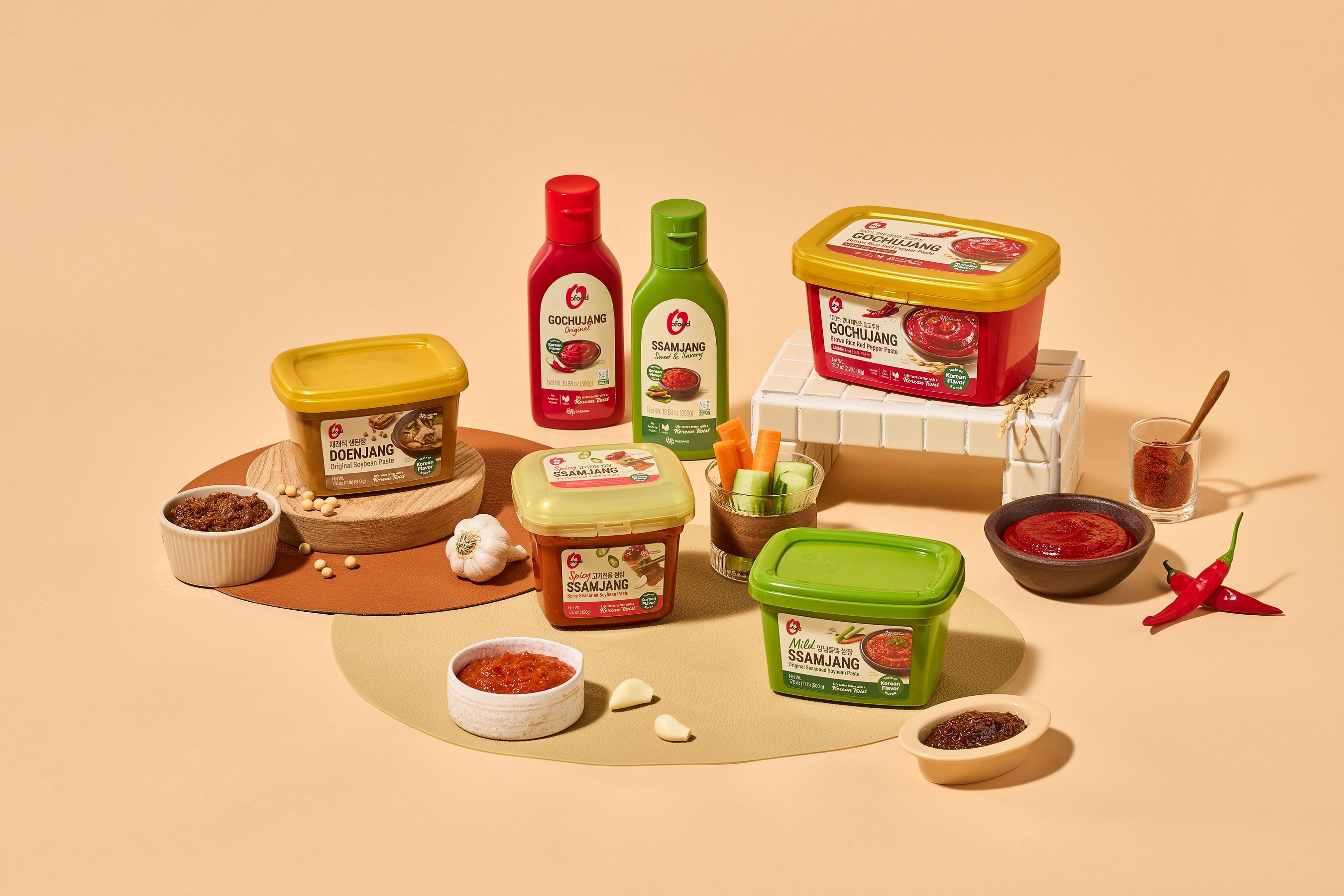
Korean food manufacturer Daesang Corporation is scaling its global sauce play in the United States, betting that mainstream retail appetite for Korean flavors has moved well beyond the ethnic-aisle niche. The company's Ofood brand now ships roughly 480 sauce SKUs to approximately 60 countries, with the U.S. designated as a priority growth market as it marks its 70th anniversary this year.
The Numbers
The clearest proof point is Ofood's Natural Gochujang, the brand's tube-format table sauce that trades the thick paste consistency of traditional gochujang for a thinner, pour-ready texture and a milder fermented aroma. The product is already stocked at Walmart and ranked as Daesang's top sauce export, posting year-over-year sales growth of approximately 84% in 2025. That velocity suggests the product has cleared the credibility hurdle that stalls many imported condiments: repeat purchase at mass retail.
Daesang has structured sauces as one of four core global categories alongside kimchi, gim (Korean seaweed), and convenience foods — a signal that the segment is carrying real capital investment, not just opportunistic export volume.
Portfolio & Channel Fit
Beyond Natural Gochujang, the Ofood lineup is engineered for multi-occasion use, a quality that travels well into convenience and foodservice channels. Gochujang Tteokbokki Hot Sauce — built around the spicy-sweet profile of Korean street food — is positioned for pasta and gnocchi applications in addition to its traditional use. All Purpose Korean BBQ Sauce, made primarily from soy sauce and gochujang, works as a marinade, stir-fry base, or dipping sauce. Chicken Dipping Sauce targets the K-chicken trend with a gochujang base, while Mayo Gochujang — a gochujang-mayonnaise blend — is explicitly aimed at burgers and fries, a combination that maps cleanly onto c-store foodservice programs and roller-grill condiment sets.
The format and flavor logic here aligns with what convenience operators have been chasing in dispensed-beverage and back-of-house condiment programs: bold, globally inspired profiles that require minimal consumer education and translate across dayparts.
Outlook
Eun-young Park, Head of Daesang's Food Business Unit, framed the strategy around cultural momentum rather than niche positioning: "Traditional Korean fermented sauces and pastes such as gochujang are gaining attention as versatile sauces that local consumers can incorporate into everyday meals." The company plans to deepen mainstream retail distribution globally while continuing to develop market-specific sauce formulations.
For c-store buyers and category managers tracking the condiment and sauce segment, the Ofood expansion is worth watching alongside broader K-food penetration data. NACS research has consistently shown that younger convenience shoppers over-index on international flavor profiles, and gochujang's crossover into QSR — where chains from McDonald's to regional fast-casual operators have tested Korean-inspired LTOs — typically signals downstream demand at the forecourt.
Daesang operates manufacturing subsidiaries in the United States, Poland, China, Indonesia, and Vietnam, meaning domestic supply continuity is less of a sourcing risk than it would be for a purely import-dependent brand. That infrastructure detail matters for foodservice procurement conversations where supply reliability ranks alongside price and velocity.
Written by Michael Politz, Author of Guide to Restaurant Success: The Proven Process for Starting Any Restaurant Business From Scratch to Success (ISBN: 978-1-119-66896-1), Founder of Food & Beverage Magazine, the leading online magazine and resource in the industry. Designer of the Bluetooth logo and recognized in Entrepreneur Magazine's "Top 40 Under 40" for founding American Wholesale Floral, Politz is also the Co-founder of the Proof Awards and the CPG Awards and a partner in numerous consumer brands across the food and beverage sector.