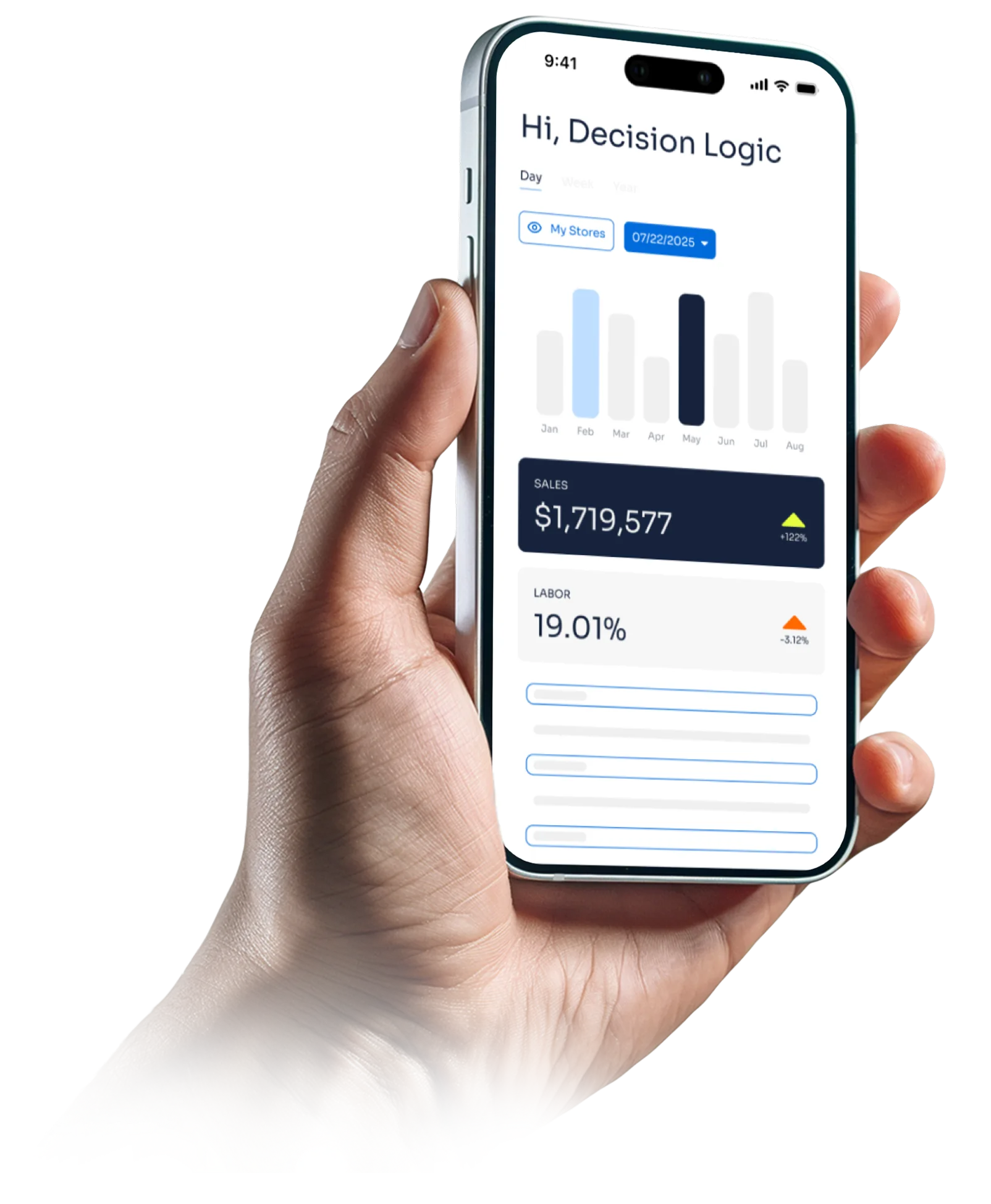
Restaurant back-of-house software provider Decision Logic launched Open Semantic Access on Sept. 17, giving multi-unit operators the ability to pipe their operating data — sales, labor, inventory, food cost — directly into AI tools such as ChatGPT, Claude, and Gemini without paying a per-location fee to unlock the capability.
The feature is positioned as a first-to-market offering in the restaurant operations software segment. Rather than locking operators into a proprietary AI chat interface, Open Semantic Access provides read-only data exports alongside semantic definitions that teach a third-party AI tool what the numbers actually mean — distinguishing gross from net sales, for example, or a case count from individual unit counts — before any query is run.
The Problem It Solves
For multi-unit foodservice operators, answering a business question that falls outside an existing dashboard can become a weeks-long project: export data restaurant by restaurant, reconcile formats, and queue a custom report. Decision Logic estimates Open Semantic Access can compress that cycle by three to four times in applicable use cases.
The practical shift is meaningful for back-of-house operations teams managing hundreds of locations. An operator could use the capability to compare ideal versus actual menu-item performance, model true guest traffic trends, or build a margin view from live operating data — tasks that previously required a new report build or a separate business intelligence license.
No Per-Location Toll
Decision Logic is bundling Open Semantic Access at no additional charge for existing platform customers. The company illustrates the competitive contrast with a hypothetical: an AI or API add-on priced at $300 per restaurant would run a 450-unit operator more than $135,000 annually — a figure that compounds with every new opening. Decision Logic charges no per-location activation fee.
"Restaurant operators shouldn't have to buy their own data back just because they want to use it with AI," said Keegan Conrey, CEO of Decision Logic. "Open Semantic Access is built around a straightforward principle: it's your data. You should be able to use it with the tools you choose, ask the questions that matter to your business and get answers without waiting for someone else's roadmap."
The bring-your-own-tool approach also gives operators flexibility as the AI landscape evolves. Customers supply their own credentials and can swap AI platforms without losing the underlying data connection — a meaningful hedge as large language model preferences shift quickly across the industry.
Current Decision Logic partners include 54th Street Restaurants, RibCrib BBQ, Golden Corral, Taco John's, and Twin Peaks. The capability is available now; operators can see it demonstrated at the FSTEC 2026 conference or request a demo directly.
For c-store operators running attached or standalone foodservice programs at scale, back-of-house data visibility is an increasingly critical lever. As restaurant-style foodservice at c-stores grows more complex — with made-to-order programs, commissary-sourced items, and layered labor models — the tools that multi-unit restaurant chains adopt for food cost intelligence and labor optimization are becoming relevant benchmarks for convenience channel operators managing similar back-of-house complexity.
Written by Michael Politz, Author of Guide to Restaurant Success: The Proven Process for Starting Any Restaurant Business From Scratch to Success (ISBN: 978-1-119-66896-1), Founder of Food & Beverage Magazine, the leading online magazine and resource in the industry. Designer of the Bluetooth logo and recognized in Entrepreneur Magazine's "Top 40 Under 40" for founding American Wholesale Floral, Politz is also the Co-founder of the Proof Awards and the CPG Awards and a partner in numerous consumer brands across the food and beverage sector.