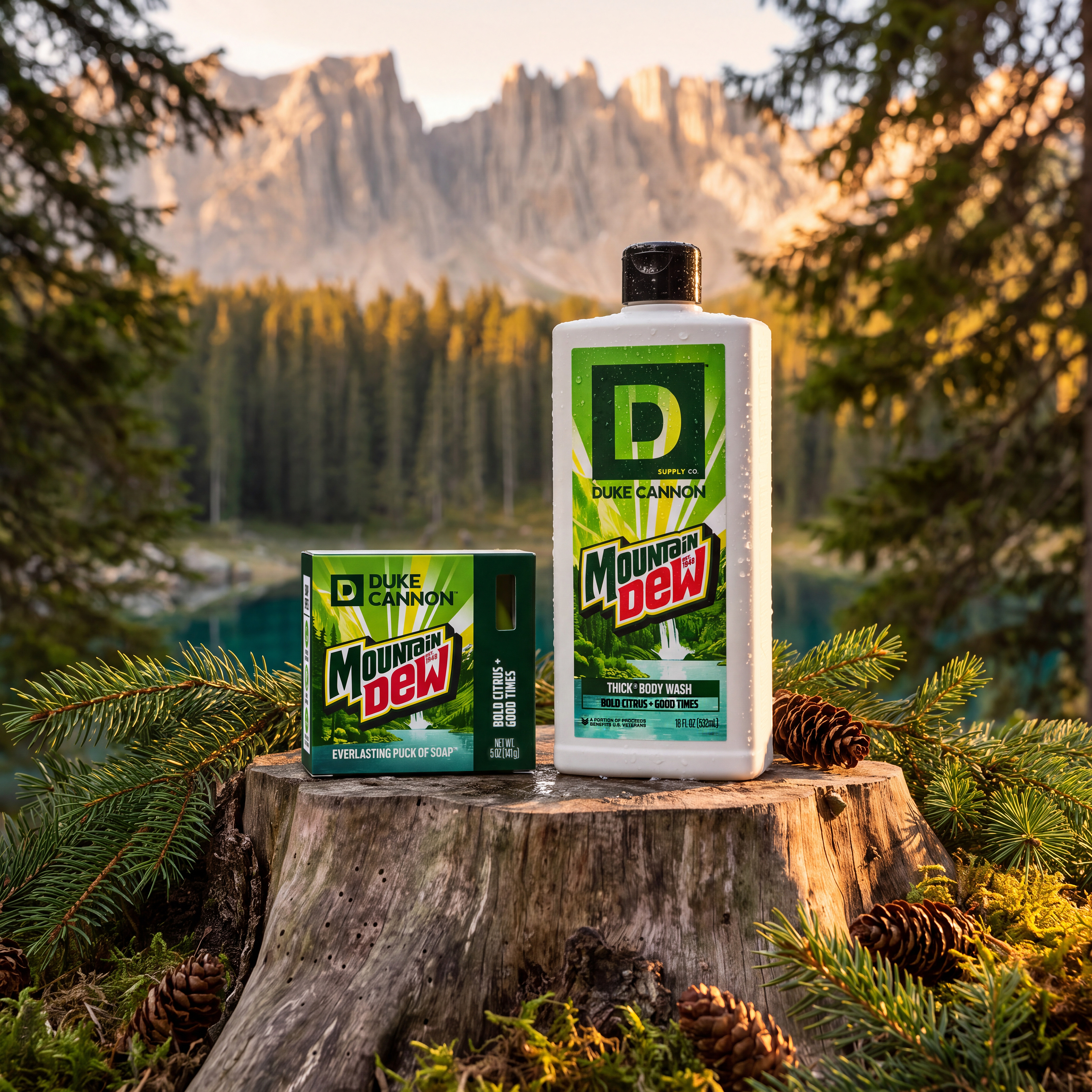
Men's grooming brand Duke Cannon and PepsiCo's Mountain Dew have teamed up on a limited-edition soap and body wash collection timed to the back end of summer, landing exclusively in Walmart stores and on Walmart.com through September.
The collaboration produces two SKUs — a THICK Body Wash and a signature long-lasting Puck of Soap — both scented with the brand's Bold Citrus and Good Times profile, a lemon-and-eucalyptus formula intended to evoke outdoor activity. Starting September 1, shoppers can also purchase a bundle on Walmart.com that pairs the two grooming items with a 12-pack of Mountain Dew, positioning the drop as a cross-category impulse buy rather than a straight personal-care play.
Why C-Stores Should Watch
Licensed beverage-to-CPG collabs have become a reliable traffic driver in the mass and convenience channel, and this one is structured to move product at the register. The packaging leans into Mountain Dew's loud, high-visibility aesthetic — by design, according to both partners — to compete for eyeball real estate on crowded shelving. The arrangement was facilitated by IMG Licensing, the sports and entertainment agency that has brokered similar brand-extension deals for major consumer names.
For c-store category managers tracking personal-care adjacencies, the move illustrates how beverage brands are increasingly monetizing their equity beyond the cooler. Mountain Dew already commands strong impulse purchase rates in the convenience channel, and cross-category licensing gives licensees like Duke Cannon a built-in fan base to market toward. The outdoor-adventure positioning also aligns with the core c-store shopper profile — on-the-go, value-conscious, and responsive to recognizable brand names on unfamiliar products.
Channel Context
"Together with Mountain Dew, we're celebrating the people who embrace adventure, stay true to themselves and never pass up an opportunity to make the most of every moment," said Kathy Dixon, marketing director at Duke Cannon. The quote reflects a broader strategy: both brands are targeting the same skewing-male, activity-oriented consumer who frequents the forecourt as much as the mass retail aisle.
While the initial Walmart exclusivity limits immediate c-store shelf placement, limited-edition grooming collaborations anchored to beverage IP have historically found their way into convenience sets once mass exclusivity windows close — a pattern worth tracking for personal-care buyers. Duke Cannon's existing retail footprint at major chains suggests the brand has the distribution infrastructure to expand quickly if the collab generates the sell-through its packaging is designed to trigger.
For operators already stocking dispensed beverages and packaged drink adjacencies, the Mountain Dew licensing angle is a useful reminder that PepsiCo's brand portfolio extends well beyond the cooler door. Retailers looking to build out cross-category impulse zones — a tactic gaining traction in convenience-channel merchandising strategies — may find the Duke Cannon model worth benchmarking when the Walmart window closes.
Written by Michael Politz, Author of Guide to Restaurant Success: The Proven Process for Starting Any Restaurant Business From Scratch to Success (ISBN: 978-1-119-66896-1), Founder of Food & Beverage Magazine, the leading online magazine and resource in the industry. Designer of the Bluetooth logo and recognized in Entrepreneur Magazine's "Top 40 Under 40" for founding American Wholesale Floral, Politz is also the Co-founder of the Proof Awards and the CPG Awards and a partner in numerous consumer brands across the food and beverage sector.