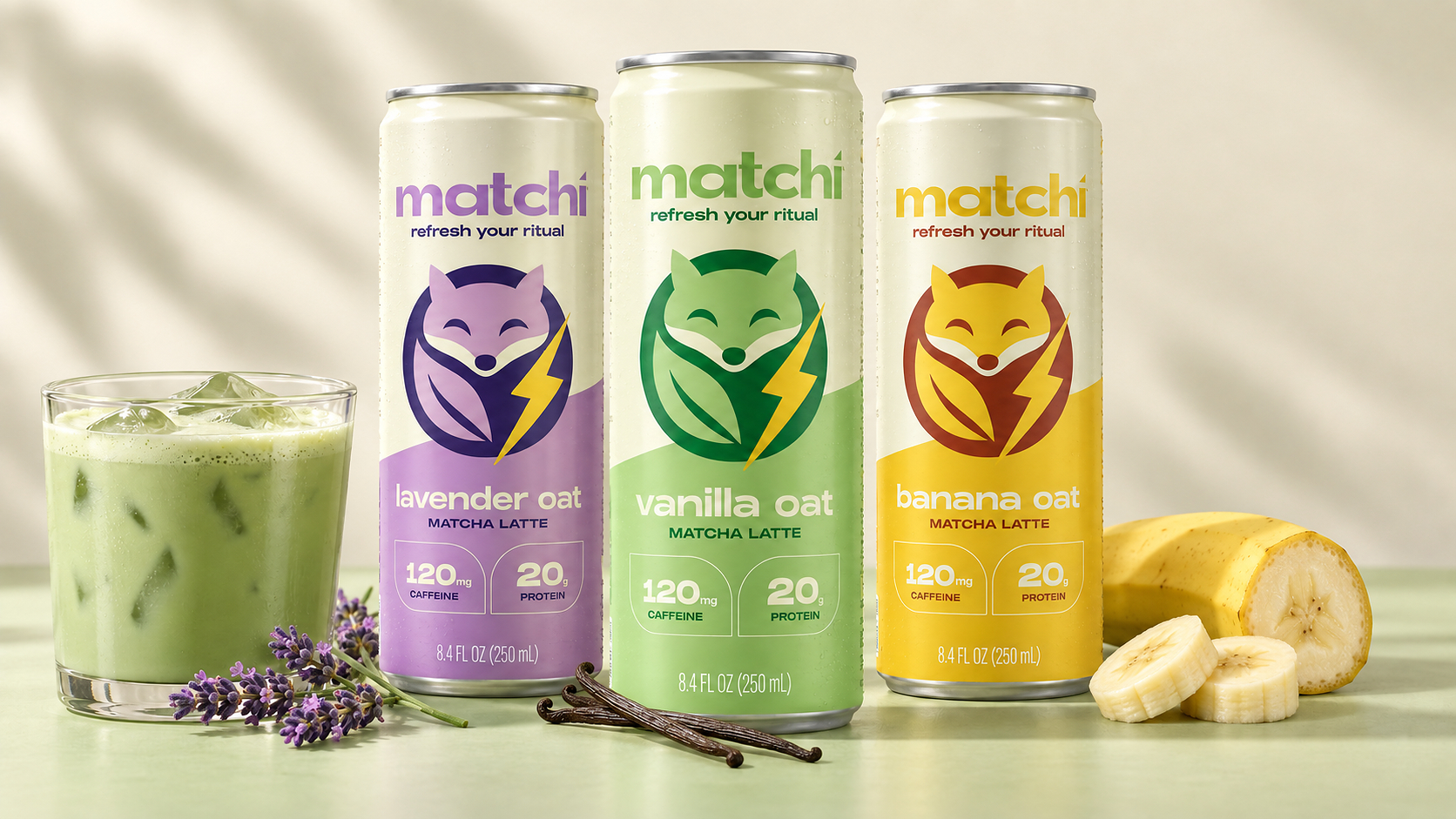
Alexandria, Va.-based Matchi Global LLC is entering the ready-to-drink protein-beverage set with a canned matcha latte positioned to compete in the same cooler doors as established high-protein RTDs. The launch puts 20 grams of complete filtered milk protein — covering all nine essential amino acids — alongside ceremonial-grade matcha and 4 grams of prebiotic fiber in a shelf-stable 8.4 oz can. Pre-orders opened September 22 at drinkmatchi.com, with first fulfillment slated for December 2026.
The Product
Matchi launches in three flavors — Vanilla, Lavender, and Banana — each delivering roughly 120 mg of caffeine, comparable to a strong espresso. The formulation carries no artificial flavors, colors, sweeteners, or preservatives. Founder Jordan Martinez, a U.S. Air Force veteran, framed the positioning plainly: "We're not a protein drink company with matcha. We're a matcha company with 20 grams of protein." The drink is designed to read as a latte first — creamy on the open, flavor-forward through the middle, with a smooth matcha finish — rather than a functional shake.
The 8.4 oz can size fits neatly into single-serve cooler planograms already built around energy drinks and premium RTD coffee. For c-store buyers evaluating the dispensed-beverage and packaged-cold adjacency, the format and caffeine content place Matchi squarely in the functional-beverage consideration set alongside brands like Celsius and OWYN.
Category Tailwinds
The timing reflects two converging trends that have reshaped c-store cold-vault strategy over the past several years. U.S. high-protein shakes and RTDs reached $8.1 billion in 2025, up 71% from $4.7 billion in 2021. Separately, U.S. matcha demand hit $478.8 million in 2024 and is projected to reach $762.6 million by 2030, with North America identified as the fastest-growing region globally. No major RTD player currently occupies the protein-plus-ceremonial-matcha overlap in a canned format, which is the gap Matchi is targeting.
For operators, the protein-beverage segment has become one of the more reliable inside-sales drivers in the cold vault. Shoppers trading up from standard energy drinks toward cleaner-label, functional alternatives have made premium RTD a growth lever even as unit traffic has softened at many chains.
Go-to-Market Path
Matchi's initial go-to-market is DTC-only through drinkmatchi.com, sold in 12-packs and 24-packs with a subscription option that brings the per-can cost below $4. A planned Spring 2027 retail activation in Washington, D.C. — timed to the National Cherry Blossom Festival — will serve as the brand's first physical-retail proof point, with select independent retail distribution to follow before any national chain rollout.
That sequencing — DTC ramp, regional independents, then national accounts — is a familiar emerging-brand retail-entry playbook that allows a startup to build velocity data and loyalty before approaching large chain buyers. C-store category managers evaluating the brand will likely watch the D.C. independent-retail phase closely for velocity-per-store figures before committing cooler space. Matchi is also assembling a beverage-industry advisory board, with members to be announced ahead of the December fulfillment window.
Written by Michael Politz, Author of Guide to Restaurant Success: The Proven Process for Starting Any Restaurant Business From Scratch to Success (ISBN: 978-1-119-66896-1), Founder of Food & Beverage Magazine, the leading online magazine and resource in the industry. Designer of the Bluetooth logo and recognized in Entrepreneur Magazine's "Top 40 Under 40" for founding American Wholesale Floral, Politz is also the Co-founder of the Proof Awards and the CPG Awards and a partner in numerous consumer brands across the food and beverage sector.