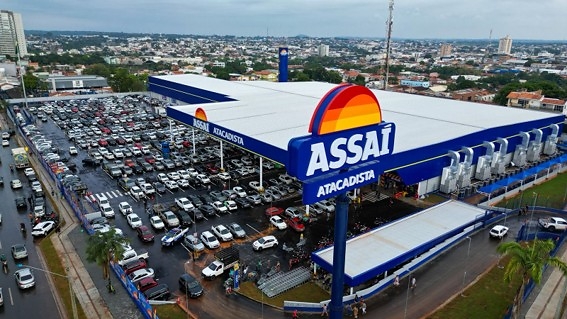
Brazilian wholesale grocer Assaí added 18 gas stations in the São Paulo market during the third quarter of 2026, planting its flag in convenience and fuel retail as the company posted a 55.2% jump in adjusted recurring net income to R$248 million.
The forecourt acquisition — disclosed alongside Q3 earnings — signals Assaí's most direct move yet into the channel overlap between cash-and-carry food retail and convenience. Operations at the 18 sites are scheduled to begin in August 2027, giving the company roughly eight months to build out its back-of-house model, staffing structure, and product assortment before cutting the ribbon.
The Numbers
Gross revenue for the quarter reached R$21.3 billion, up 2.7% year over year, while gross margin expanded 45 basis points to 17.2%. Adjusted EBITDA held at R$1.1 billion on a stable 5.7% margin. Strict expense management — cost growth of 4.2% against an IPCA inflation rate of 4.4% — drove most of the margin preservation. Twelve-month operating cash flow of R$3.3 billion allowed the company to cut net leverage to 2.15x from 3.03x a year earlier, and a 61.0% decline in receivables-discounting costs helped trim net financial expenses by 8.8%. Customer traffic rose 2.1%, with monthly footfall surpassing 40 million shoppers despite persistent household debt pressures across Brazil.
"The third quarter demonstrated Assaí's ability to safeguard operations and make progress on variables within our control," said Belmiro Gomes, CEO of Assaí. "We remain firmly focused on cash generation, competitive pricing, operational efficiency, and financial discipline."
Ecosystem Build-Out
The gas-station play is one leg of a broader ecosystem push that also includes healthcare and private label. Assaí Farma, the company's pharmacy format, closed Q3 with 11 units in São Paulo — all opened between July and November — and remains on pace to reach 25 pharmacy doors by December. The company also launched a pharmacy e-commerce channel inside its 'Meu Assaí' loyalty app, with in-store pickup, and extended its dietary supplement set to 300 stores.
On the private-label front, Assaí added more than 30 SKUs during the quarter, pushing its total to 140 items across the Assaí, Assaí Chef, Econobom, and new Assaí Bloom banners, with a target of 250 SKUs by year-end. Last-mile delivery sales — a rough analog to the dispensed-beverage and grab-and-go convenience model gaining ground globally — grew 204.0% across 104 stores, reinforcing the digital and convenience pillar ahead of the forecourt launch.
What It Means for the Channel
For operators tracking international c-store expansion and fuel-retail M&A, Assaí's move is a notable data point: a high-volume food retailer using strong cash flow and a deleveraging balance sheet to buy its way into the forecourt rather than build from scratch. The 18-unit São Paulo cluster gives Assaí immediate site density in Brazil's largest metro, a playbook familiar to any operator who has watched grocery-anchored fuel programs develop in Europe and the U.S. How the company layers foodservice, private-label convenience items, and its existing loyalty infrastructure onto those sites will be the story to watch when doors open in mid-2027.
Written by Michael Politz, Author of Guide to Restaurant Success: The Proven Process for Starting Any Restaurant Business From Scratch to Success (ISBN: 978-1-119-66896-1), Founder of Food & Beverage Magazine, the leading online magazine and resource in the industry. Designer of the Bluetooth logo and recognized in Entrepreneur Magazine's "Top 40 Under 40" for founding American Wholesale Floral, Politz is also the Co-founder of the Proof Awards and the CPG Awards and a partner in numerous consumer brands across the food and beverage sector.