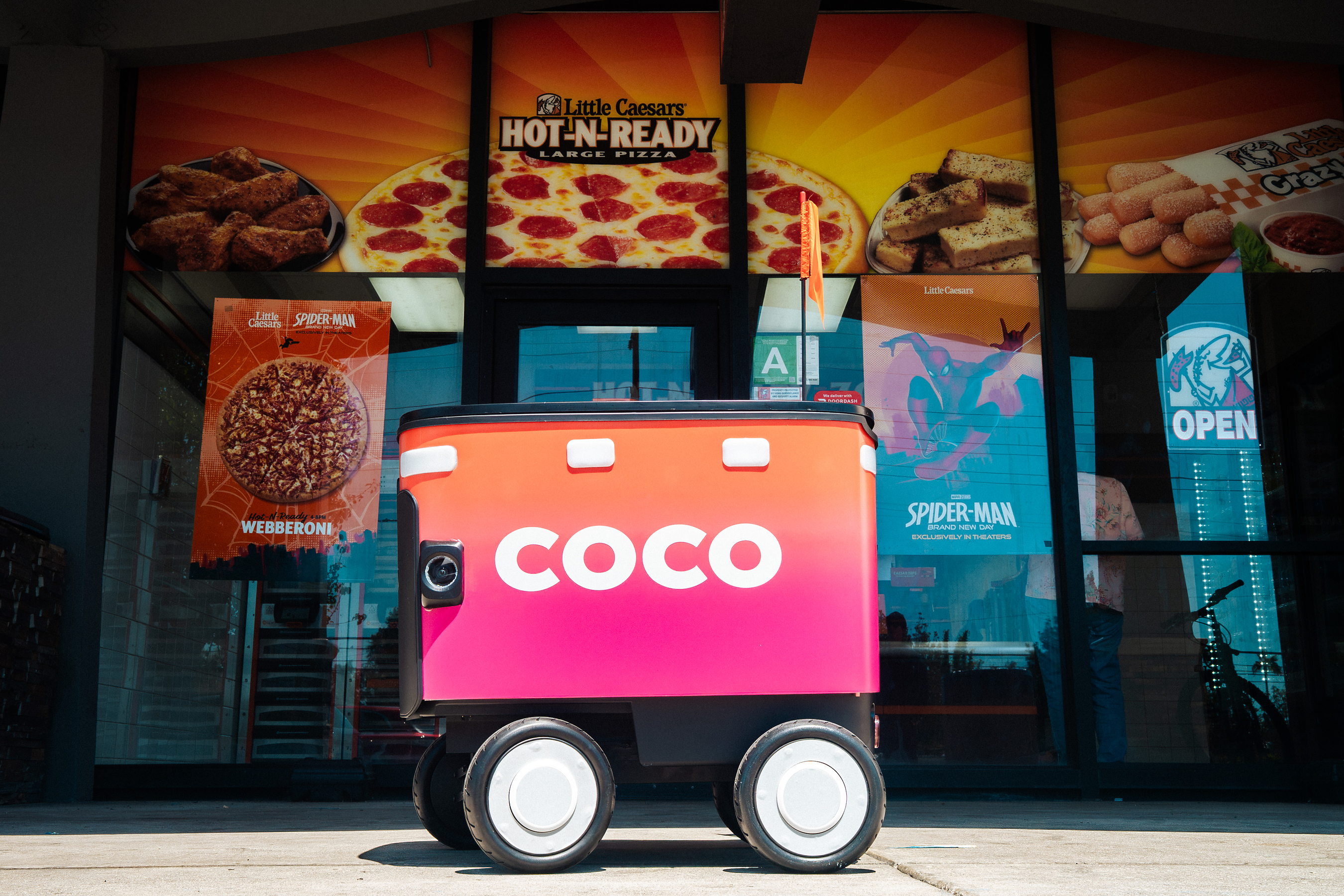
Little Caesars is deploying autonomous delivery robots from Coco Robotics at participating locations in Los Angeles, Chicago, and Miami, with downtown San Jose set to follow as Coco expands its footprint there. The rollout marks the chain's first scaled use of sidewalk robotics for last-mile fulfillment on third-party platforms.
Orders placed through DoorDash and Uber Eats at participating stores can be routed to a Coco robot without any extra steps for in-store staff — the system integrates directly into both platforms' existing ordering flows. Once a HOT-N-READY® pie is ready, it moves from the kitchen to the curb, where the robot handles the final leg to the customer's door.
Why This Matters for Operators
For franchisees managing peak-hour volume at compact Little Caesars footprints — many without traditional dine-in areas — the operational upside is tangible. Trish Heusel, VP of Innovation at Little Caesars, said the Coco integration reduces congestion inside stores and accelerates throughput during rush periods, two pressure points that routinely squeeze labor and ticket times at value-pizza units. Cutting delivery handoff friction at the forecourt level without adding headcount is a meaningful lever for single-location operators watching labor costs closely.
The pizza category sits at the intersection of two durable convenience-channel trends: the continued migration of delivery volume onto aggregator platforms and growing operator interest in automation tools that extend throughput without expanding back-of-house staff. According to NACS data, foodservice represents the fastest-growing inside-sales category for c-store operators, and quick-serve pizza remains one of the top foodservice programs retailers benchmark against when building or upgrading their own programs. Watching how a brand like Little Caesars manages last-mile speed at scale offers a relevant data point for any operator running a made-to-order foodservice program.
Scale and Recognition
Coco Robotics reports it has completed more than 500,000 zero-emission deliveries across the U.S. and Europe since its 2020 founding. The company describes its fleet as continuously trained on real-world operational data, which it says enables faster market entry when expanding to new cities — a claim San Jose will help test. The Little Caesars partnership has already drawn two 2026 Franchise Innovation Awards: Innovator of the Year for Operations & Technology and Most Innovative Use of Technology.
Melissa Fahs, VP of Enterprise at Coco Robotics, framed the collaboration as proof that autonomous delivery can operate at chain scale rather than as a pilot curiosity. For c-store operators evaluating similar last-mile or on-demand delivery arrangements — whether through aggregators or proprietary apps — the Little Caesars-Coco model is worth tracking as a reference point on integration complexity and store-level workflow impact.
The broader rollout timeline and participating-store counts have not been disclosed. Coverage of related foodservice technology trends and delivery channel developments at convenience retail continues on C-Store News.
Written by Michael Politz, Author of Guide to Restaurant Success: The Proven Process for Starting Any Restaurant Business From Scratch to Success (ISBN: 978-1-119-66896-1), Founder of Food & Beverage Magazine, the leading online magazine and resource in the industry. Designer of the Bluetooth logo and recognized in Entrepreneur Magazine's "Top 40 Under 40" for founding American Wholesale Floral, Politz is also the Co-founder of the Proof Awards and the CPG Awards and a partner in numerous consumer brands across the food and beverage sector.