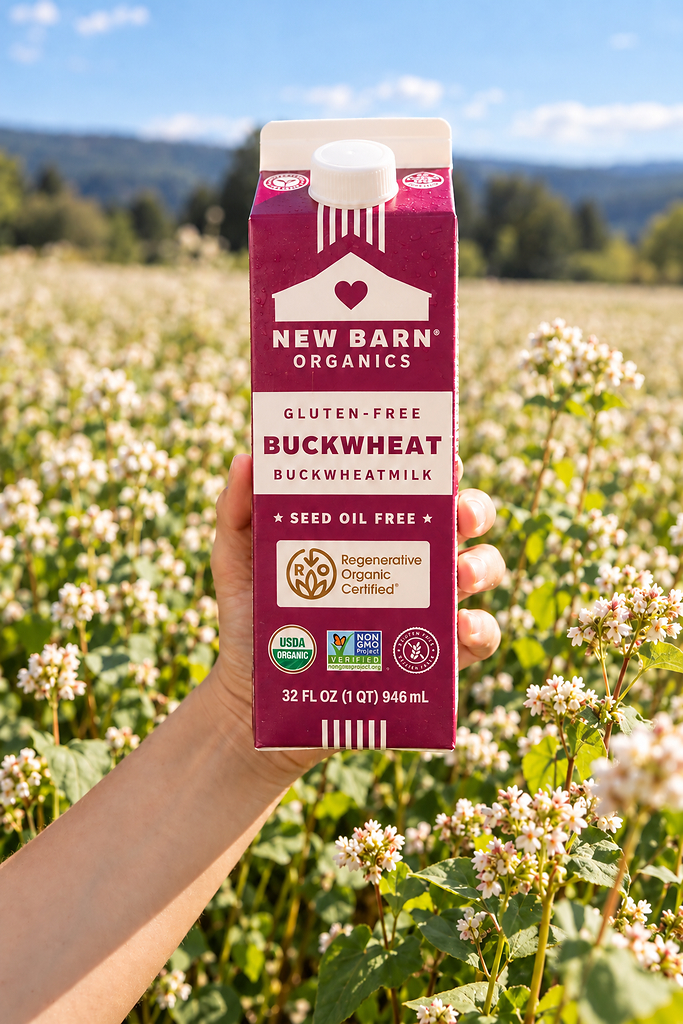
New Barn Organics is bringing buckwheat milk to Whole Foods Market shelves across Southern Pacific, Northern California, Southwest, Rocky Mountain, and Florida regions, the company announced September 29. The launch is the product of a supply-chain partnership with BAM the Brand, Inc., which pioneered America's first buckwheat-based plant milk and has since pivoted toward a B2B ingredient model.
Under the arrangement, New Barn acquired BAM's buckwheat milk recipes and will sell the finished product under its own brand. BAM supplies the proprietary Organic Buckwheat Milk Powder — a shelf-stable ingredient developed to make buckwheat scalable across food and beverage applications — and in return gains New Barn as its first commercial powder customer, a foothold for expanding into additional CPG categories.
How the Deal Came Together
The partnership originated inside Whole Foods Market's Local and Emerging Accelerator Program (LEAP), where BAM was a selected participant and New Barn served as a mentor. Lisa Tosun, Emerging Brands Forager for Whole Foods Market, said she had worked with New Barn for roughly nine years and recognized the alignment when BAM joined the LEAP cohort in 2023. "I've had the pleasure of working with New Barn Organics for about nine years now and knew when BAM joined our LEAP cohort back in 2023 that these two brands would instantly connect through their commitment to regenerative agriculture," Tosun said.
The new SKU is gluten-free, Certified Seed Oil Free, and carries the Regenerative Organic Certified® (ROC™) mark — the first New Barn product built from scratch to that standard. New Barn and BAM worked with the Regenerative Organic Alliance (ROA), the nonprofit that administers the ROC standard, to construct a compliant supply chain for the line.
Plant Milk and Regenerative Ag Context
Plant-based milk remains one of the more active alternative-dairy segments in natural and specialty retail, though the category has faced volume pressure as oat milk growth has plateaued. Buckwheat carries agronomic credentials that resonate with the regenerative agriculture movement: the crop suppresses weeds, attracts pollinators, and requires minimal inputs — attributes that differentiate it on shelf as sustainability claims become a competitive axis in the better-for-you beverage aisle.
"Plant-based milk remains a core category, and Buckwheat Milk is a natural next step as consumers seek regenerative, delicious ways to diversify their diets," said Paige Hansen, Founder and CEO of BAM the Brand. The partnership structure — an emerging startup supplying an established natural-foods brand — offers a model that other early-stage ingredient innovators may watch closely, particularly as incubator and accelerator programs at major retailers increasingly bridge the gap between emerging and established suppliers.
For the convenience and specialty food trade, buckwheat's shelf-stable powder format is worth noting: it broadens potential applications beyond refrigerated plant milks into dispensed beverage programs and back-of-house foodservice formulations, channels where clean-label and regenerative positioning are gaining traction with operators seeking to differentiate their foodservice programs. Whether buckwheat milk finds a path into alternative-dairy sets at convenience chains — as oat and almond milks have — will depend on consumer pull and the supply chain's ability to scale at competitive price points.
Written by Michael Politz, Author of Guide to Restaurant Success: The Proven Process for Starting Any Restaurant Business From Scratch to Success (ISBN: 978-1-119-66896-1), Founder of Food & Beverage Magazine, the leading online magazine and resource in the industry. Designer of the Bluetooth logo and recognized in Entrepreneur Magazine's "Top 40 Under 40" for founding American Wholesale Floral, Politz is also the Co-founder of the Proof Awards and the CPG Awards and a partner in numerous consumer brands across the food and beverage sector.