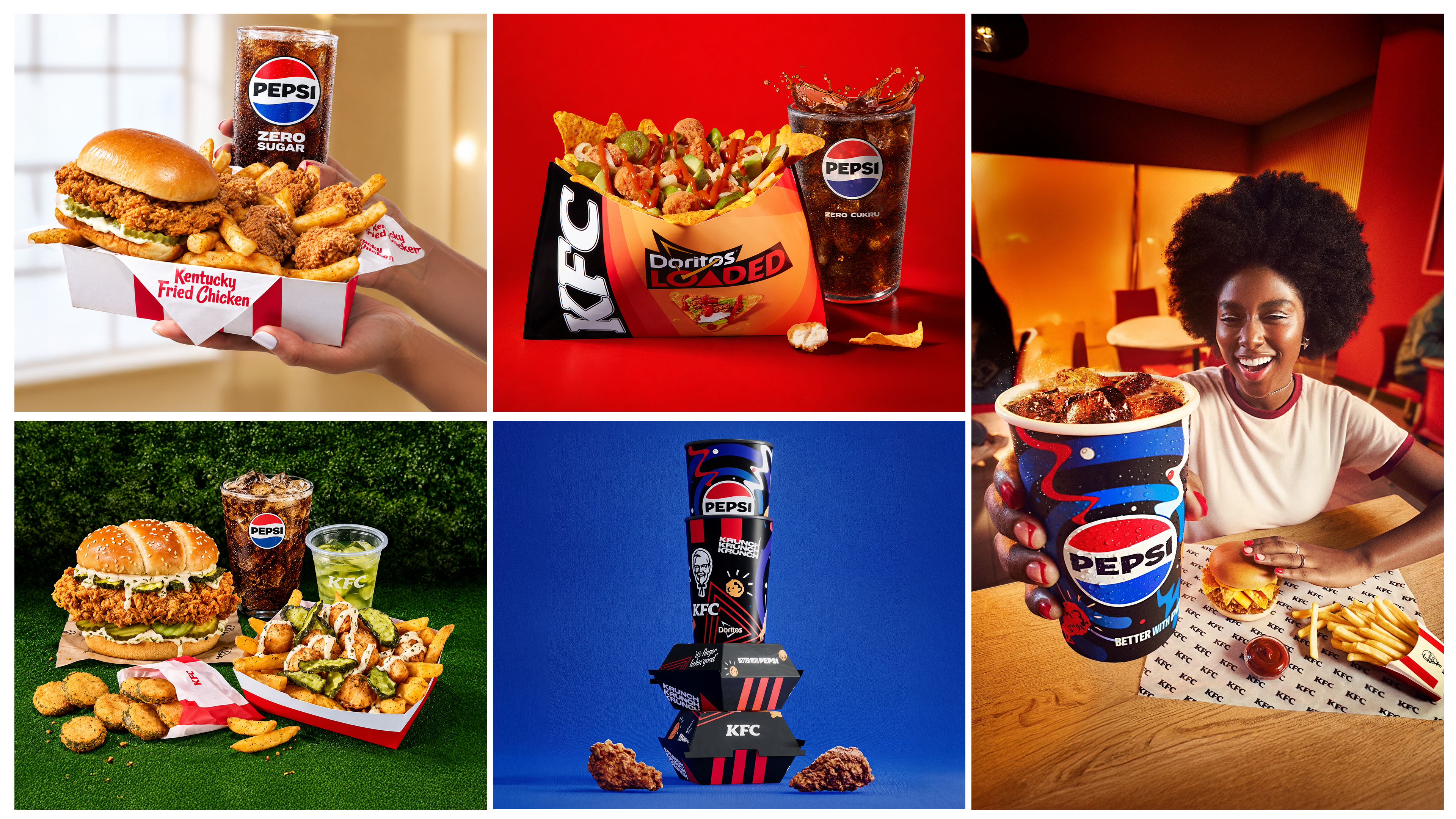
PepsiCo has locked in a renewed beverage-and-foodservice partnership with KFC across eight international markets — Australia, India, the UK, Spain, Germany, France, the Netherlands, and Belgium — extending a decades-long relationship that already spans the Middle East, Asia-Pacific, Latin America, and other regions.
The renewal keeps PepsiCo's dispensed-beverage portfolio — Pepsi Zero Sugar, Pepsi MAX, Pepsi MAX Cherry, Lipton Peach Iced Tea, and 7UP — on KFC's fountain program in those markets. It also formalizes the cross-brand culinary play: Doritos Loaded, a menu item that pairs KFC's crispy chicken tenders with Doritos corn tortilla chips and Mexican-inspired toppings, is rolling out in select markets as an exclusive offering neither brand could execute alone.
Beverages as a Growth Lever
For QSR operators watching foodservice strategy at convenience and restaurant formats alike, the beverage angle is the most consequential part of this deal. KFC is explicitly leaning into beverages as an incremental sales driver, targeting Gen Z consumers who expect crafted, functional, and energy-forward options alongside traditional carbonated soft drinks. PepsiCo's international beverage portfolio — which increasingly spans energy, hydration, and functional segments — positions it to support that category expansion in ways a single-brand supplier could not.
Eugene Willemsen, CEO of International Beverages at PepsiCo, framed the renewal around speed of relevance: "As consumer tastes continue to evolve, PepsiCo is moving at the speed of culture, bringing new capabilities and category-leading innovation, to help KFC build a more modern, distinctive, and relevant beverage business around the world."
Cross-Brand Menu Innovation
The Doritos Loaded SKU illustrates a strategy that foodservice operators across formats — QSR, fast casual, and convenience-store foodservice programs — are increasingly pursuing: converting a recognized CPG brand into a traffic-driving, exclusive menu item. For c-store operators, the parallel is relevant. Snack-brand co-branded roller grill items and dispensed-beverage exclusives follow the same logic of using brand equity to differentiate a prepared-food program and reduce consumer price sensitivity.
PepsiCo generated nearly $94 billion in net revenue in 2025 across its beverage and convenient-foods portfolio, which includes Lay's, Doritos, Cheetos, Gatorade, Mountain Dew, Quaker, and SodaStream. That scale gives it the culinary and digital infrastructure — flavor development, local-market data, digital solutions — to offer restaurant and foodservice partners more than a pour. The company describes its model for restaurant, hospitality, and travel partners as a combination of brand access, culinary capability, and consumer-focused innovation, a bundle that single-category suppliers struggle to replicate.
For c-store operators benchmarking their own dispensed-beverage and foodservice partnerships, the KFC renewal is a useful case study: beverage exclusivity and co-branded culinary items are increasingly linked in supplier negotiations, and operators who can offer both a fountain commitment and a food-program integration have more leverage with major CPG suppliers.
Written by Michael Politz, Author of Guide to Restaurant Success: The Proven Process for Starting Any Restaurant Business From Scratch to Success (ISBN: 978-1-119-66896-1), Founder of Food & Beverage Magazine, the leading online magazine and resource in the industry. Designer of the Bluetooth logo and recognized in Entrepreneur Magazine's "Top 40 Under 40" for founding American Wholesale Floral, Politz is also the Co-founder of the Proof Awards and the CPG Awards and a partner in numerous consumer brands across the food and beverage sector.
Frequently Asked Questions
Which eight international markets are covered under PepsiCo's renewed KFC beverage deal?
Australia, India, the UK, Spain, Germany, France, the Netherlands, and Belgium. This renewal extends PepsiCo's existing KFC partnerships already active in the Middle East, Asia-Pacific, and Latin America, solidifying fountain presence across major developed and emerging markets.
What specific beverage brands does PepsiCo supply to KFC under this deal?
Pepsi Zero Sugar, Pepsi MAX, Pepsi MAX Cherry, Lipton Peach Iced Tea, and 7UP are the core portfolio on KFC's fountain program. This mix targets both traditional carbonated soft-drink consumers and the growing Gen Z demand for functional and craft beverage options.
What is Doritos Loaded and why does it matter for convenience store operators?
Doritos Loaded pairs KFC's crispy chicken tenders with Doritos corn tortilla chips and Mexican-inspired toppings — an exclusive co-branded menu item that demonstrates how QSR cross-category plays drive transaction size. It shows the playbook: neither brand executes this alone, so the partnership creates differentiation competitors can't easily replicate.
Why is PepsiCo positioning this as a beverage-growth strategy, not just a supply agreement?
KFC is explicitly targeting Gen Z with crafted, functional, and energy-forward options beyond traditional CSDs. PepsiCo's expanded international portfolio — spanning energy, hydration, and functional segments — gives KFC capabilities to modernize its beverage business faster than a single-category supplier could.
How should c-store operators interpret this deal's competitive implications?
This signals that fountain-beverage exclusivity and cross-brand culinary innovation are now table stakes for QSR partnerships. If your suppliers aren't moving at the speed of culture and bundling functional categories with traditional CSD, you're already behind competitors who are.