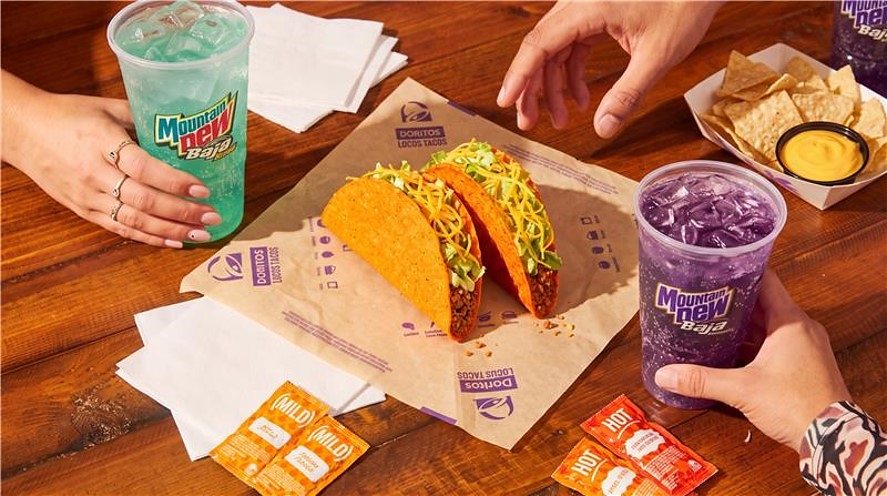
Taco Bell and PepsiCo have extended their U.S. foodservice beverage partnership through 2036 — an 11-year commitment that keeps Mountain Dew Baja Blast exclusive to Taco Bell locations nationwide and sets the table for a new wave of crafted, functional, and energy drink innovation across the quick-service chain's domestic footprint.
The renewed agreement covers participating Taco Bell, Taco Bell Cantina, and Live Más Cafe locations. PepsiCo's on-premise portfolio — Pepsi, Pepsi Zero Sugar, Mountain Dew, Starry, Baja Blast, and Baja Midnight — continues as the default dispensed beverage lineup at those units. Internationally, PepsiCo will also serve as Taco Bell's beverage partner in Canada, the United Kingdom, Ireland, and Thailand, with market-specific programs tailored to local consumers and restaurant operators.
What the Deal Covers
Mountain Dew Baja Blast, born from the original partnership more than two decades ago, has grown into a billion-dollar brand. The renewal doubles down on that platform: limited-time expressions like Baja Midnight, a pink seasonal Baja Blast, and food tie-ins such as Baja Blast Pie and Baja Blast Gelato have kept the line culturally active between core menu cycles. DORITOS Locos Tacos — another co-creation from the PepsiCo–Taco Bell pipeline — turns 15 in 2027, and the companies say new flavors are planned for that anniversary.
Beyond legacy SKUs, the next chapter targets emerging occasion dayparts. PepsiCo and Taco Bell plan to develop energy beverages aimed at Gen Z consumers and designed to capture morning and afternoon visits — a daypart where the chain has historically trailed breakfast-forward c-store competitors. The Refrescas premium beverage platform, already in market as an elevated pairing option, is also part of the extended roadmap alongside functional beverage formats.
Why It Matters for Operators
For the convenience and foodservice channel, exclusive dispensed beverage arrangements like the Baja Blast deal represent one of the stronger traffic-driving mechanics in QSR — a lesson c-store foodservice programs have been absorbing as proprietary beverage bars become a competitive battleground. Chains that lock in signature, exclusive dispensed beverages consistently outperform peers on repeat visit frequency, particularly among loyalty members.
"Some of PepsiCo's best foodservice innovations have come from partnerships that challenge us to think differently, and Taco Bell has always brought that energy," said Anne Fink, President of PepsiCo Global Away from Home. "What makes this partnership special is how we bring together Taco Bell's connection to culture with PepsiCo's consumer insights, culinary capabilities and beverage expertise."
Meg Farren, Taco Bell's President, North America, framed the renewal around system-wide value: "PepsiCo has been a trusted partner for over two decades, and we look forward to continuing to work hand-in-hand to drive long-term growth for the Taco Bell brand and create greater value across our system."
For c-store operators watching QSR-at-cstore foodservice trends, the deal underscores how deeply integrated beverage and food co-development has become in high-volume away-from-home accounts — and how much runway proprietary platforms still have when supported by consistent limited-time execution. PepsiCo reported nearly $94 billion in net revenue in 2025, with its away-from-home division representing a key growth vector as on-premise recovery continues across all foodservice formats.
Written by Michael Politz, Author of Guide to Restaurant Success: The Proven Process for Starting Any Restaurant Business From Scratch to Success (ISBN: 978-1-119-66896-1), Founder of Food & Beverage Magazine, the leading online magazine and resource in the industry. Designer of the Bluetooth logo and recognized in Entrepreneur Magazine's "Top 40 Under 40" for founding American Wholesale Floral, Politz is also the Co-founder of the Proof Awards and the CPG Awards and a partner in numerous consumer brands across the food and beverage sector.